
Truth and Verisimilitude
- Mar 13, 2016
- 3 min read

I wanted to preface this blog post by saying that by the writing of this post I am only halfway through the book and there will be spoilers.
Since starting to read V for Vendetta, I was enthralled by the meaning behind the actions done and words spoken in the book by all of the characters. The most interesting character by far is V. The scene which I find most interesting is the chapter versions. In this portion of the book V talks to the statue of Justice above the Old Bailey, and the leader of England is communing with Fate. Both characters have conversations with their “lovers” in their own ways and reach a conclusion about themselves by doing so.

The Leader of England, whose name is Adam Susan, is a man of great power and control. But in this scene he shows himself to be much different than he appears on the outside. The Leader sees himself as the leader of the lost people and the ruins of civilization. He also sees himself as the person to lead England out of the harsh times of the 20th Century. Finally he is a Fascist. The goes on to speak about the origin of Fascism. The Romans with the philosophy that one twig may get snapped, but a bundle of twigs cannot ever be broken. This idea of unity creating strength is the basis of his thoughts. He justifies the uniformity of thought that the state preaches by saying the creation of unity will have to be done without freedom and liberty which people once had. The only liberty left in his mind is the liberty of starvation, which he hopes to shed his people from. The leader goes on to talk about his love of Fate. He says that because he loves Fate which does not love him back, he is able to thrive. Fate is able to have those who love her touched by God and Destiny, while Freedom and Luxuries were lost in war. This mindset is terrifying. A man who is willing to throw all that makes him unique away in exchange for the power of a king who rules a country in fear. Leader seems to be willing to give up all that makes him human for a chance at power.
The second half of the chapter focuses on V. V is standing on top of The Old Bailey building with the statue of Justice. V has a conversation with the statue of Justice in which he talks about his love of Justice from a young age. Then goes on to say that he hates Justice now and has found his new love of Anarchy. The quote from the novel that best captures his feelings is as follows:
“Her name is Anarchy. And she has taught me more as a mistress than you ever did! She has taught me that Justice is meaningless without Freedom. She is honest. She makes no promises and breaks none. Unlike you Jezebel.”
Quote is the meaning of the V motives so far in the book. The state has taken away Freedom. And as such the Justice of the state is therefore corrupted and becomes a liar. V who loved Justice found a replacement in Anarchy. He says that Anarchy makes no promises and breaks none. This is because Anarchy has no rule over anything. No say on any matter. No philosophies that can only be realized in an ideal world. Anarchy is just the Freedom of nothingness. V believes in this because the state has taken all other Freedoms away from the people. It is just like the old saying: When life gives you lemons, make lemonade. But instead of lemons and lemonade it is nothing and Anarchy.
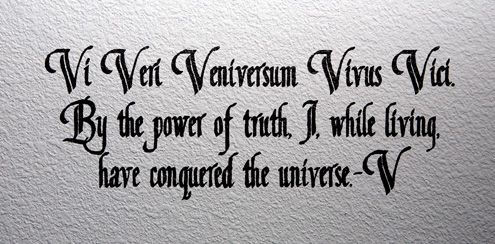
This vision of the world by V is one of truth. He wants the truth of Freedom, Justice, Fate, and Anarchy to be shown to the world in full truth. The devotion to Fate that takes away one’s humanity. The loss of Freedom in the world. The corruption of Justice. And finally the truth within the nothingness, Anarchy. V wishes to show England the truth of Freedom and Liberty. The verisimilitude in Justice is not enough. Anarchy is not destruction of the world, but rather the Freedom from lies and false promises.


Comments